
The API economy has transformed how organizations connect systems, share data, and automate processes. For more than a decade, APIs have been the backbone of digital strategy. But today, we are entering a new era — one shaped by intelligent agents capable of reasoning, collaborating, and taking real action on behalf of the enterprise.
As these agentic systems mature, a critical question has emerged in regard to how Enterprise organizations can orchestrate agents at scale.
How will companies create secure, structured, business-aligned workflows when autonomous digital workers can observe, plan, and act on their own?
This is where Model Context Protocol (MCP) is quickly emerging as the next major standard.
APIs Are The Foundation of Enterprise Connectivity
APIs provided organizations with a standardized way to exchange data and trigger actions across systems. API-powered processes are fundamentally static: predefined, predictable, and limited to what systems expose. The rise of iPaaS (such as Workato) has enabled more standardized and secure ways to work with APIs, delivering advanced workflow automation and orchestration. iPaaS platforms enable developers to build integrations faster without compromising security and scalability.
Traditional integration frameworks require logic to be explicitly designed within pre-defined workflows. As we begin building AI-based agents that require context, data, rules, and the ability to take action in systems, it has become clear that an enhanced framework standard would be helpful.
The promise of AI-driven intelligent agents is to have enhanced capabilities, including the ability to:
- Interpret unstructured information.
- Make decisions with context.
- Interact and take action within applications
- Proactively suggest and initiate next steps in a chain of actions.
- Collaborate with other agents.
- Take action independently, collaboratively with other agents, and with the guidance of human oversight.
This new suite of capabilities requires an enhanced form of orchestration that blends traditional integration with dynamic reasoning and real-time context sharing.
Why Model Context Protocol Is Essential for Enterprise AI Orchestration
Most people recognize LLMs as passive systems that generate text, images and videos when prompted. Agentic AI advances this concept by enabling systems that can take controlled, autonomous actions in enterprise applications, such as HR platforms, CRMs, ERP systems, or bespoke internal applications. However, to enable this capability, we need a secure, reliable, and traceable way to connect the LLM to these applications. That’s exactly the purpose of the Model Context Protocol (MCP). Its purpose is to standardize how models interact with external systems.
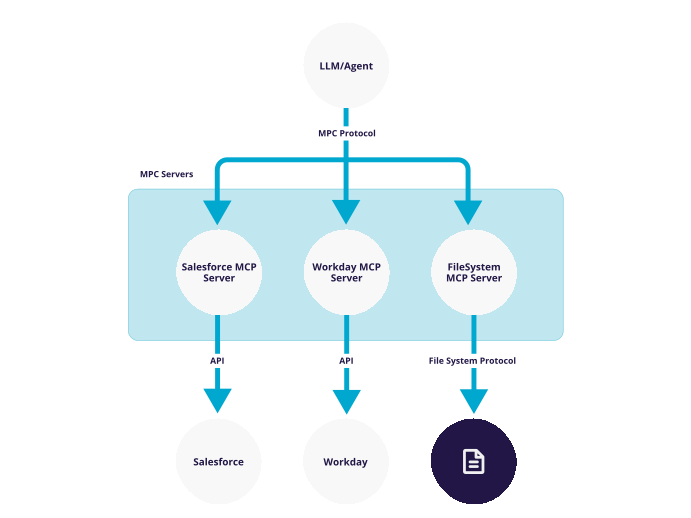
SaaS applications expose their functionality via APIs. An MCP server adds a layer on top of these APIs in the form of structured, schema-defined operations (“tools”) that the LLM can operate on without needing to know anything about authentication, connection details, or the mechanics of calling those APIs.
MCP is the protocol. When you implement it in your language of choice and expose its tools over any supported transport (e.g. HTTP or Websockets), you now have an MCP Server. This server is the bridge between the LLM and the target systems. Because the protocol is standardized, any MCP-compatible LLM can interact with the MCP server regardless of the language or platform used to implement it.
For example, when you (or another agent) ask an LLM to “Create a new lead in Salesforce” or “Lookup the vacation for John in Workday”, the MCP server coordinates the skills and tools necessary to take that action.
It’s important to note that the exposure of the external applications to the LLM is not unbounded. The LLM cannot access these systems directly; instead, it can only call the specific tools the MCP server exposes. It’s the MCP server’s job to define these boundaries; this ensures the autonomy remains controlled, auditable and safe.
Imagine a sales operations team that needs to identify all stale leads across regions, enrich them with internal data, and reassign them based on routing rules stored in a spreadsheet. Normally, this requires a custom integration or application. With MCP, you simply expose a few high-level tools, such as get_leads, enrich_lead, and reassign_lead, and the LLM can coordinate the workflow autonomously. It can decide which leads qualify as stale based on the provided context, determine what enrichment is needed, and take the appropriate actions — all without any explicit programming.
The LLM does not know how to connect to these systems; the MCP server enables the LLM to perform these operations. The LLM only knows it can call a tool called create_sales_lead, which is exposed by the MCP server. It does not need to know how to connect to the CRM, whether it uses a token-based or API key approach, what the API endpoints are, or what business logic the endpoints expose. The MCP server handles these nuances and complexities.
The Enterprise Problems MCP Is Designed to Fix
Model Context Protocol (MCP) is an open standard first proposed by Anthropic, designed to create a standardized method for connecting AI applications to systems and data sources. As an open standard, every LLM and AI system that supports the standard can be “plugged in” without significant effort. The MCP standard is designed to accelerate AI agentic development velocity, enhance reusability, introduce governance and constraints to improve AI safety, and facilitate the creation of agentic ecosystems where agents can collaborate in multi-step workflows.
Before the advent of MCP, connecting to Saas and internal applications required custom integrations that were bespoke and inflexible. Due to the lack of standardization, every integration had to reinvent how AI agents called the APIs. There was no observability and security guardrails. LLM’s could accidentally access, modify and expose sensitive data without constraints or alerts – it was entirely dependent on the type and quality of the interface. These bespoke integrations were complex to scale due to unique requirements and different patterns. And ultimately, they eroded trust in enterprise-grade Agentic AI, because of the lack of control.
MCP standardizes and solves many of these problems. An MCP server provides tools and schemas, and it enforces authentication and permission boundaries. A well-architected MCP server provides logging, tracing, and governance hooks, offering a secure, LLM-friendly way to take controlled actions.
Why Forward-Looking Enterprises Are Adopting MCP Now
APIs aren’t going anywhere, and MCP enhances their capabilities in the AI era. As AI agents become part of the enterprise workforce, MCP is emerging as the connective tissue that allows them to operate securely, reliably, and effectively.
Organizations that embrace this shift early will enable new forms of productivity and adaptability that traditional integration approaches simply cannot match.
As enterprises adopt intelligent agents and MCP-based orchestration, the underlying challenge is architectural, strategic, and operational. Dispatch can help you build your agentic roadmap and architecture, and implement your MCP tools and capabilities in order to orchestrate the operational lifecycle of your agentic workforce.